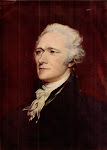
It has again been a long period of absence from blogging, and I have hardly written the promised series on Thomas DiLorenzo's Hamilton's Curse at all. My greatest apologies.
After having introduced my argument and my standpoint in my introductory installment, I would like, in this post, to examine the theory itself. This post will look at what DiLorenzo himself says, and what he claims to be true. Please notice that I will be using DiLorenzo's own words to make my case; I will not base my argument on the words of reviewers and readers, whether they are admirers or opponents of DiLorenzo. Notice also that DiLorenzo's failure to faithfully apply this method to his presentation of Hamilton's views, will be shown to be a key weakness in his theory.
Let me preface my remarks by saying the following: my attacks are not against DiLorenzo or his adherers personally; it is against historical revisionism. Let me further state that I am not presently combating revisionism for its own sake -- one could spend perhaps a thousand lifetimes refuting every lie about history that has ever been passed down to the present generation. I am refuting taking the time to refute this one in particular for two reasons:
- Based on the Ninth Commandment, I am convinced that it is morally wrong to falsely accuse people, particularly godly people, of heinous crimes, without sufficient evidence and logic.
- By attacking Hamilton, and labeling him a "treacherous Founder," we discourage Americans to seriously peruse his writings, or the writings of other Federalists like John Jay or Fisher Ames. By ignoring the writings of these men, we ignore their sound wisdom and advice, and we miss out on their incredible insight into human nature, and how liberty can be preserved in a republic. The writings of Jefferson and Paine are poor substitutes, because the writings of those two men are tinctured (strongly, I might add) with the philosophy of humanistic individualism. This kind of philosophy is contrary to Christianity, contrary to federal republicanism, contrary to the spirit of law, and contrary to the spirit of the Constitution. We are left with a biased view of our nation's history, and we therefore fail to see that it is not monarchism or even mercantilism, but rather the philosophy of humanism, that sent our nation whirling down the drain to perdition, tyranny, and which ultimately will send us to our destruction.
The following is from the introduction (can be read in full here) of his book, Hamilton's Curse (pages 2-4):
Hamilton was one of the most influential figures in American political history. He served as a delegate at the Constitutional Convention of 1787; was one of the authors of The Federalist Papers, which helped convince the states to ratify the Constitution; and was the nation's first treasury secretary. Throughout these critical early years of the American republic, Hamilton made clear his political philosophy. To begin with, he wanted a highly centralized government. He spoke out against the nation's first constitution, the Articles of Confederation, precisely because he felt it did not give enough power to the national government, and at the Constitutional Convention he proposed a permanent chief executive who could veto all state legislation -- in other words, an American king. ... Unlike Hamilton, [Jefferson] was a "strict constructionist" with regard to the Constitution: he believed the national government had only those select powers (mostly for foreign affairs) that the sovereign states had expressly delegated to it in the Constitution; all others were reserved to the states respectively, or to the people, as enunciated in the Tenth Amendment. [emphasis original]
Alright. Let me get this straight. First, Hamilton is one of the men most responsible for the Constitution's existence. Next thing you know, he's working really hard to destroy it, and the civil rights it guarantees to citizens. Is this logical? If this is so, than there must have been either a sudden change in Hamilton's motives and beliefs. And this change is most likely caused by the opportunity of gaining wealth and power in advocating arbitrary central government. We'll examine this in a moment. But first, we'll let DiLorenzo continue:
Hamilton wanted to use this centralized power to subsidize business in particular, and the more affluent in general, so as to make them supportive of an ever-growing state. As treasury secretary, he was a frenetic tax-increaser and advocated government planning of the economy. He championed the accumulation of public debt, protectionist tariffs, and politically controlled banks; belittled politicians like Jefferson who spoke too much of liberty; and believed that the new American government should pursue the course of national and imperial glory, just like the British, French, and Spanish empires.
... [Jefferson] believed that interfering in the affairs of other nations for the sake of "imperial glory" [elsewhere, Dilorenzo claims that these words are Hamilton's] was a disastrous mistake.
... On another occasion [Jefferson] summed up his view even more succinctly: 'That government is best which governs least.' The motto of Hamilton, the consummate statist, might well have been "That government is best which governs most.'"
[T]he triumph of Hamiltonianism has been mostly a curse on America. The political legacy of Alexander Hamilton reads like a catalog of the ills of modern government: an out-of-control, unaccountable, monopolistic bureacracy in Washington, D. C.; the demise of the Constitution as a restraint on the federal government's powers; the end of the idea that the citizens of the states should be the masters, rather than the servants, of their government; generations of activist judges who have eviscerated the constitutional protections of individual liberty in America; national debt; harmful protection international trade policies; corporate welfare (that is, the use of tax dollars to subsidize various politically connected businesses); and central economic planning and political control of the money supply, which have instigated boom-and-bust cycles in the economy.
Here is, perhaps, the most astonishing implication of the theory: Hamilton accomplished all of this damage in his short lifetime, outnumbered by the other Founders who of course were liberty-lovers. He did all this as Secretary of the Treasury, and President Washington and the Congress (the same Congress which framed the Bill of Rights, including the Tenth Amendment) did little or nothing to stop him. DiLorenzo would have us believe that Washington agreed with all of Hamilton's dangerous policies, out of blind trust. And that doesn't even deal with the issue of Congress approving Hamilton's policies. What are we to believe? That Washington and the framers of the Bill of Rights suddenly took stupid pills every morning of every day that Hamilton was in the Treasury???
Hamilton could not have possibly accomplished all of this alone, without the approval of the Congress and the President. That is the point. Unless DiLorenzo comes up with some alibi to explain all of this away, we may see yet another shocking release from DiLorenzo's pen:

And now for the "motive" approach. Here, we will have to deal with some of the facts relating to the case. DiLorenzo rightly says that Hamilton was not so stupid as to believe that these things would create a free America; no, he had ulterior motives. As DiLorenzo puts it:
Hamilton and his political compatriots, the Federalists, understood that a mercantilist empire is a very bad thing if you are on the paying end, as the colonists were. But if you are on the receiving end, that’s altogether different.So, DiLorenzo argues that Hamilton and his friends were on the “receiving end” of this arbitrary central governing system they created. We should expect that Hamilton, as being successful in his evil efforts (as DiLorenzo himself states), should have been made affluent and wealthy and powerful, and made his rich friends even more rich and powerful. Hamilton, according to the introduction of Hamilton's Curse, served a limitless ambition and thirst for power, and it was all because of him that we have the political and economic problems that we have today. He opposed liberty-lovers like Thomas Jefferson, and betrayed the American Revolution.
"Our Founding Financial Dictator"
Let's put this in some historical context. Hamilton comes on the scene of the American Founding, first as writing pamphlets in defense of the colonists against the tyrannical British government. He writes two pamphlets, “A Vindication of the Measures of the Continental Congress” (1774) and “The Farmer Refuted”(1775). In the latter, Hamilton makes the case, based mostly upon natural law, that the only just kind of government is the kind of government that is based upon the law of God (both natural and revealed) and upon the consent of the governed. He gives up the study of law, and forgoes graduating from Kings College (now Columbia) to join an artillery corps, which was one of the most well-trained and well-equipped units of the Continental Army until Baron Von Steuben (working with Hamilton) arrived and trained the troops. Hamilton risked his life (there are anecdotes of his close encounters with death throughout the war) in defense of America, his adopted country, on the fields of New York, Trenton, Princeton, and Yorktown.
If it was ambition Hamilton sought, he no doubt would have chosen the easier road (who would have thought the American army would beat the British?) and become a Loyalist. The American War held little promise for a young penniless orphan with no relations in America, unless he was motivated by principle to share in the sufferings of his adopted country. And you cannot be motivated by principle if you are a power-hungry schemer.
Jefferson, on the other hand, was not quite the dedicated revolutionary. Oh yes, he was an eloquent patriot, but when he was governor of Virginia, and the British came to arrest him and take the capital city, Richmond, he fled on horseback, and gave up the city without a fight. This action flung the gates wide open for the British to continue to march southward unimpeded, and continue their bloody warfare. General Washington was greatly disappointed and disgusted at the news, for he was relying upon Jefferson to afford the British some resistance. Patrick Henry, who had previously been governor, was so appalled at this act, that he urged Congress to declare Jefferson a coward. The motion was ultimately never successful, but this fact nevertheless marks Jefferson's character.
And yet, we are to believe that Hamilton was the betrayer of the Revolution, and Jefferson, its unsuccessful defender.
In the next post, we will continue to examine the "motive issue" upon which DiLorenzo's theory hinges. We will examine the little-known facts of history to discover just what Hamilton gained from his efforts, and if these facts coincide or contradict DiLorenzo's theory. From there, we will address the specifics of DiLorenzo's accusations.